UK
 Canada
 Colombia
 India
 Jamaica
 Philippines
 US
 SA
If you are preparing for a call centre interview, there is a strong chance you will be asked: What are your strengths and weaknesses? It can sound like a simple question, but employers use it to understand how well you know yourself and how your abilities fit the role.
The answer must sound sincere, relevant and backed up with examples. You do not need to come across as someone without flaws, but rather as someone who understands their strengths and areas for improvement, and is ready to learn.
The following tips will help candidates for call center jobs prepare role-relevant responses.

Why interviewers ask about strengths and weaknesses
When you are asked about your strengths and weaknesses during an interview, it is not enough to simply state personal qualities. Instead, the interviewer wants to know about your self-awareness, integrity, fit for the position and ability to take constructive criticism.
Call centre jobs often involve repetitive customer interactions, targets, new systems, challenging interactions and coaching. Employers therefore value candidates who are self-aware and willing to adapt.
They may also be considering what are their strengths and weaknesses across a wider group of candidates. Your answer gives them another way to compare how your qualities could support customer service, teamwork and day-to-day performance.
A good response can demonstrate that you know what the actual job is like and not simply provide a clichéd interview answer.
For broader preparation, explore our ultimate guide to interview success or visit the interview hub.

How should you structure your answer?
If you are wondering how to answer what are your strengths and weaknesses, keep your structure simple.
For strengths:
- Name the specific strength.
- Provide an example that proves the presence of the strength.
- Explain how it helps you in a call centre role.
For weaknesses:
- Name one that is true and non-critical to the job.
- Explain how you recognised the weakness.
- Discuss the actions you are taking to fix it.
You can also use the STAR approach when giving examples. It means Situation, Task, Action and Result and will help you stay on track while providing real evidence for the interviewer.
If you are asking yourself how to answer what are your strengths, think about qualities you have already demonstrated in work, study, volunteering or team situations. Then connect them directly to the role.
Best strengths for call centre jobs
Candidates often search for what are your strengths best answer or the best answer to what are your strengths, but there is no single perfect response. The best answer is one that is true, relevant and supported by evidence.
Here are 10 strengths that work well for call centre roles.
1. Active listening
Listening actively ensures that you know what the customer's problem is before replying.
Sample answer:
“One of my strengths is active listening. I focus on what the customer is saying, ask clarifying questions and confirm important details before offering a solution.”
2. Clear communication
Call centre representatives should explain information clearly and professionally.
Sample answer:
“Communication is one of my strengths and I adapt my wording to the customers.”
3. Empathy
Empathy allows customers to feel understood, especially if they are angry.
Sample answer:
“I can understand how the customer feels and react to that calmly. This builds my credibility before I move on to solutions.”
4. Patience
Patience is important when customers need extra explanation or when a problem takes time to resolve.
Sample answer:
“I stay patient during longer conversations and make sure the customer understands the next step instead of rushing them.”
5. Problem-solving
Customer service often involves identifying issues quickly and finding practical solutions.
Sample answer:
“I enjoy solving problems. I look at the information available, identify the cause and work through the most appropriate solution.”
6. Resilience and composure
Call centre work can involve difficult conversations and busy periods.
Sample answer:
“I stay composed under pressure. If a call is challenging, I focus on the issue rather than taking the customer's frustration personally.”
7. Adaptability
Processes, products and systems can change, so flexibility matters.
Sample answer:
“I adapt quickly to new procedures. I make notes, ask questions and practise until I feel confident using the new process.”
8. Attention to detail
Accurate records and clear notes can support both customers and colleagues.
Sample answer:
“I pay close attention to details, particularly when recording customer information or checking the next steps before ending a call.”
9. Multitasking
Agents may need to speak with customers while reviewing account details or using several systems.
Sample answer:
“I can manage several tasks while keeping the customer conversation focused and organised.”
10. Teamwork
Customer service teams often rely on shared knowledge and support.
Sample answer:
“I enjoy working as part of a team. I share useful information and ask colleagues for input when it helps us reach the right outcome.”
If you are still asking what a good answer to What are your strengths, choose two or three strengths from this list that genuinely reflect your experience.
You can also review the best customer service skills to identify abilities that are especially valuable in customer-facing roles.

Best weaknesses for call centre jobs
Knowing how to answer what are my weaknesses is often harder than discussing strengths. The aim is not to choose a weakness that makes you unsuitable for the role. Instead, choose something genuine and show what you are doing about it.
Here are some example answers to ‘what are your weaknesses? that can work when explained carefully.
Nervous public speaking
“I can feel nervous speaking in front of large groups. I have started volunteering to present short updates in team settings so I can build confidence.”
Difficulty saying no
“I sometimes take on too much because I want to help. I am improving by checking priorities before committing to extra work.”
Impatience with slow systems
“I can become frustrated when systems are slow. I have learned to stay focused on what I can control and keep the customer informed.”
Being overly detail-oriented
“I sometimes spend too long checking small details. I now use time limits and checklists so I can balance accuracy with efficiency.”
Nerves with new software
“I can be cautious when first using unfamiliar software. I improve by practising early and asking questions before I start handling live tasks.”
Taking feedback personally
“I used to take feedback personally. I now treat it as practical information and focus on the action I can take to improve.”
Delegating
“I sometimes try to handle too much myself. I am working on recognising when another person is better placed to help.”
If an interviewer asks what is your biggest strength, the same principle applies. Pick one strength that matters to the role and prove it with a short example.
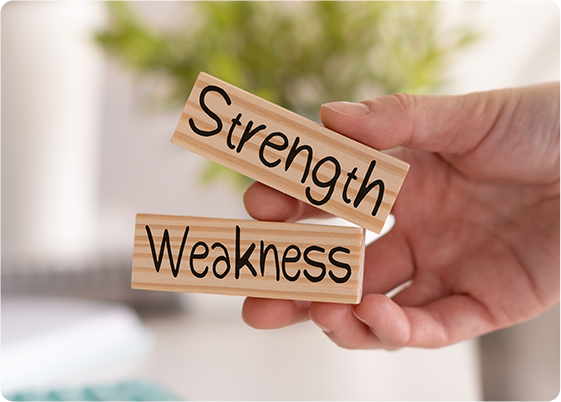
Strengths and weaknesses to avoid mentioning
There are some responses that can hurt your performance in an interview since they could come across as rehearsed, unrealistic, or inappropriate for customer service.
Clichéd answers such as “I am a perfectionist,” unless you are able to demonstrate how this made an impact and what actions you took to improve yourself, are not very original since most interviewers hear this quite often, making it seem like a hidden strength.
Here are other fatal weaknesses for a call centre job:
- Weak communication skills.
- Lack of patience with customers.
- Inability to cope with stress.
- Losing your temper easily.
- Rejection of criticism.
- Dislike of working as part of a team.
Unoriginal weaknesses are also fairly simple to recognise. Answering that “I work too hard” or “I care too much” will not get you anywhere.
The phrase what are your strengths & weakness may appear often in interview searches, but your answer should never feel copied from a script. Focus on strengths relevant to customer service and weaknesses that show self-awareness without undermining your suitability.

Tips for delivering your answer with confidence
If you are trying to learn how to respond when asked about your strengths, preparation could help make your answer sound very natural.
- Select your example ahead of time before going into the interview.
- Ensure that every response has one major idea.
- It is better to practice speaking it than memorizing the entire response.
- The response should have examples from work, school, volunteer work or daily routine.
- Answers should not be too lengthy or too detailed.
- In answering about weaknesses, it is essential to remain positive.
- It should include the steps you are taking to overcome these weaknesses.
- Take a moment and pause before responding if need be.
- Ensure that your strengths match the job position.
If your interview will be held by phone, our phone interview tips can help you prepare your tone, pace and environment.
Key takeaways
The best way to answer what your strengths and weaknesses are is to be specific, honest and relevant to the role.
The ideal response should include both self-knowledge and substantiation. State your strength, provide an instance, and explain how it supports customer service. For weaknesses, pick one that is genuine but manageable and explain the steps you are taking to work on it.
If you are wondering how to answer what your strengths and weaknesses are, avoid searching for a perfect script. Interviewers are more likely to respond well to a clear, believable answer that reflects your experience.
FAQ
-
Should I be completely honest about my weaknesses?
Yes. Pick one that is true but not very critical and describe what you are doing about it.
-
What strengths work best for a work-from-home call centre role?
The most effective advantages of working remotely include communication, self-discipline, adaptability, time management, dependability, and computer proficiency
-
What other questions are asked in call centre interviews?
Anticipate queries regarding challenging clients, working as part of a team, goals, solving problems, motivation, communication, and pressure.
-
What is a strengths-based interview?
It focuses on what you naturally do well, what motivates you and how your strengths align with the role.
Preparing clear examples can make interview questions feel much more manageable. If you are ready to put your strengths into practice, explore current customer service jobs in the UK and discover opportunities to build your customer service career with HGS.