India
India Canada
 Colombia
 Jamaica
 Philippines
 UK
UK US
US SA
SAArtificial intelligence continues to evolve rapidly, transforming how businesses operate and how people interact with technology. One of the latest developments in this field is Agentic AI, a concept that focuses on intelligent systems capable of acting autonomously to achieve specific goals.
For beginners and professionals exploring careers in artificial intelligence, understanding what is agentic AI is becoming increasingly important.
In this guide, the meaning of agentic AI is explained in a simple, understandable way, how it differs from traditional AI systems, its key components, benefits, challenges, and what the future of agentic AI may look like.
What Is Agentic AI?
To understand what agentic AI is, it is helpful to start with the basic idea of an “agent.” In artificial intelligence, an agent is a system that can observe its environment, make decisions, and take actions to achieve certain objectives.
Agentic AI, explained simply, refers to AI systems that are capable of acting independently, making decisions, and adapting to new information without constant human supervision. It can:
- Analyse situations
- Make decisions based on available data
- Take actions to achieve goals
- Continuously learn and improve
How Does Agentic AI Differ from Traditional AI?
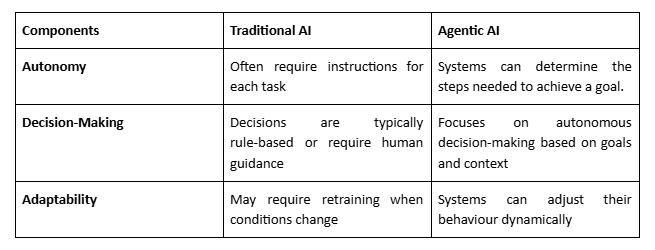
Understanding agentic AI vs traditional AI helps clarify why this technology is gaining attention.
Traditional AI systems typically operate using fixed rules or trained models. They perform tasks such as recognising images, answering questions, or predicting trends. However, they usually require human guidance for decision-making and task management.
Agentic AI systems, on the other hand, are designed to operate more independently.
Key Components of Agentic AI
Agentic AI systems are built using several important components that enable them to operate autonomously and achieve specific goals.
Autonomous Decision-Making
One of the most important agentic AI components is the ability to make decisions independently.
These systems evaluate data, analyse potential outcomes, and choose actions that help achieve defined objectives.
Learning & Adaptation
Agentic AI systems continuously improve their performance by analysing outcomes and adjusting their behaviour. This adaptive capability is one of the major agentic AI benefits.
Learning and adaptation also support innovation in emerging AI careers, where professionals build intelligent systems that evolve over time.
Goal-Oriented Actions
Rather than completing isolated tasks, agentic AI systems plan sequences of actions that move them closer to their goals. This goal-driven approach is central to many agentic AI applications, including research automation, supply chain optimisation, and digital assistants.
Why Is Agentic AI Important?
The growing interest in agentic AI is largely driven by the significant benefits of agentic AI for businesses, organisations, and technology professionals.

Increased Efficiency and Productivity
One of the main agentic AI benefits is improved efficiency. By automating decision-making processes and complex tasks, organisations can complete work faster and reduce operational costs.
For example, companies using agentic AI applications can automate data analysis, customer support workflows, and system monitoring.
Improved Problem Solving
Agentic AI systems are capable of analysing large amounts of information and identifying solutions to complex problems.
Because they continuously evaluate new data and adjust their strategies, they can address challenges that traditional systems would find difficult to handle.
Human Augmentation
Rather than replacing humans, agentic AI often works alongside people to enhance their capabilities.
Professionals can use agentic AI tools to:
- Analyse data faster
- Generate insights
- Automise repetitive tasks
As a result, new opportunities are emerging in AI careers, and many professionals are exploring the AI engineer roadmap to develop skills needed to work with advanced AI technologies.
The growing impact of AI on jobs is also prompting professionals to learn more about AI-driven technologies and how to collaborate with intelligent systems.
How Does Agentic AI Work?
Understanding how does agentic AI work requires looking at the stages involved in how these systems process information, make decisions, and improve over time.

Data Input and Processing
Agentic AI systems begin by collecting and analysing data from various sources, such as user interactions, business databases, and online information.
Once the data is processed, the system can interpret the environment and identify possible actions.
Learning and Adaptation
In this stage, the system uses machine learning techniques to identify patterns and improve its understanding of the environment. Continuous learning enables agentic AI systems to adapt to changing situations.
Decision Making and Action
After analysing data and learning from past experiences, the AI system determines the most effective action to achieve its objective.
This stage highlights the core capability of AI for decision-making, where the system evaluates options and selects the best course of action.
Feedback Loops
Agentic AI systems rely on feedback loops to improve performance.
After taking an action, the system evaluates the results and uses that information to refine future decisions. This continuous improvement process is essential for many advanced agentic AI applications.
Challenges and Considerations of Implementing Agentic AI
Despite its advantages, organisations must also consider several agentic AI challenges when implementing this technology.
- Ethical Concerns: Autonomous decision-making systems raise questions about accountability and transparency.
- Data Quality: Agentic AI systems rely heavily on high-quality data. Poor data can lead to inaccurate decisions.
- System Complexity: Developing and maintaining agentic AI systems can be technically complex and resource-intensive.
- Security Risks: Autonomous systems may be vulnerable to cyber threats if not properly secured.
The Future of Agentic AI
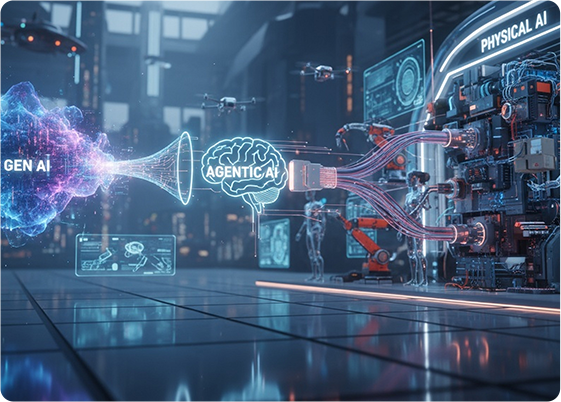
The future of agentic AI is expected to bring significant changes across industries. Possible developments include:
- Advanced autonomous digital assistants
- Intelligent business process automation
- AI-powered research and innovation tools
- Smarter decision-support systems
Conclusion
Agentic AI represents an important advancement in artificial intelligence, enabling systems to operate more independently and make intelligent decisions based on data and goals.
As organisations explore new agentic AI applications, understanding both the benefits of agentic AI and the associated agentic AI challenges will be essential.
Companies such as HGS India are actively exploring advanced technologies to improve digital experiences, enhance operational efficiency, and support the evolving role of AI in modern business environments.
FAQs
-
What are some real-world examples of Agentic AI?
Examples include autonomous digital assistants, intelligent research tools, automated trading systems, and AI-powered workflow automation platforms.
-
What programming frameworks are used to build Agentic AI?
Frameworks such as Python-based AI libraries, machine learning platforms, and agent-based development frameworks are commonly used to build agentic AI systems.
-
What industries are already using Agentic AI?
Industries such as healthcare, finance, technology, logistics, and customer service are beginning to adopt agentic AI solutions.
-
Do I need to know how to code to use Agentic AI tools?
Not always. Many AI tools offer user-friendly interfaces that enable professionals to leverage AI capabilities without advanced programming knowledge.