US
US Canada
 Colombia
 India
India Jamaica
 Philippines
 UK
UK SA
SAAgentic AI is one of the most exciting developments in artificial intelligence today. Unlike traditional AI systems that simply respond to commands or analyze data, Agentic AI can independently plan, make decisions, and execute tasks to achieve specific goals.
In this detailed guide, we will explore what agentic AI is, how it functions, the differences between agentic AI and traditional systems, its challenges, real-world applications, benefits, and prospects.
What is Agentic AI?
To begin understanding agentic AI, it is helpful to think of it as artificial intelligence capable of acting independently. The term “agentic” comes from the concept of agency, which refers to the ability to make decisions and take actions to achieve specific objectives.
Agentic AI systems are designed to operate with minimal human intervention. Instead of waiting for instructions at every step, these systems can interpret goals, determine how to achieve them, and carry out the necessary actions. This makes them fundamentally different from traditional AI models, which are typically reactive and depend heavily on predefined rules or human inputs.
For example, in a business setting, a traditional AI system might analyze customer data and generate insights. However, an agentic AI system would identify a problem, such as declining customer engagement, develop a strategy to address it, implement it, and continuously refine its approach based on results.
How Does Agentic AI Work?
To fully understand how agentic AI works, it is important to examine its core functional components. These systems operate through a structured yet adaptive process that allows them to handle complex tasks efficiently.
Goal Setting
Every agentic AI system begins with a clearly defined goal. This goal can either be provided by a human user or generated by the system itself based on contextual data.
Planning
The AI breaks down the goal into smaller, manageable tasks and determines the sequence in which they should be executed. Planning also involves identifying the tools, data sources, and resources required to complete each task.
Decision-Making
At this stage, the system evaluates multiple possible actions and selects the one that best aligns with its goal. This process often involves analyzing large volumes of data, assessing risks, and predicting potential outcomes.
Over time, as the AI gains more experience, its decision-making capabilities improve, leading to better outcomes.
Execution
Execution involves carrying out tasks in real-world or digital environments. The AI may interact with software systems, communicate with users, or trigger automated workflows.
Learning & Feedback
After executing tasks, the system evaluates the results and identifies areas for improvement. This continuous feedback loop allows the AI to refine its strategies and enhance its performance over time.
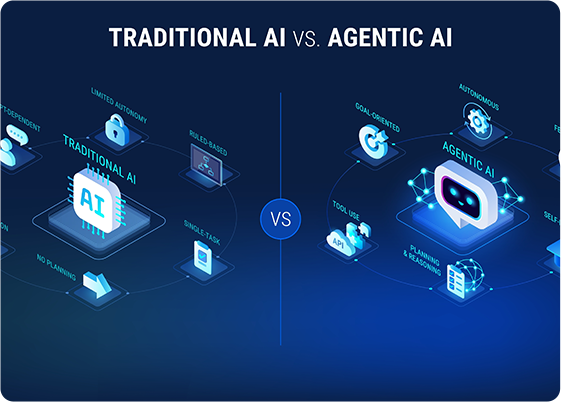
To better understand the evolution of intelligent systems, it is important to examine agentic AI vs traditional AI.
| Aspect | Traditional AI | Agentic AI |
|---|---|---|
| Core Nature | Designed to perform specific tasks based on predefined rules | Designed to act independently with goal-oriented behavior |
| Functionality | Reactive; responds to inputs or commands | Proactive; anticipates needs and initiates actions |
| Role | Functions as a tool that assists users | Acts like an intelligent assistant or collaborator |
| Decision-Making | Limited to programmed logic and rules | Capable of autonomous decision-making using real-time data |
| Task Handling | Handles single or narrowly defined tasks | Manages complex, multi-step processes |
| Flexibility | Limited flexibility; works within fixed parameters | Highly flexible; adapts to changing conditions |
| Learning Ability | Requires retraining or manual updates for new scenarios | Continuously learns and improves from feedback and data |
| Adaptability | Struggles in dynamic environments | Thrives in environments requiring constant evolution |
| Business Application | Suitable for routine automation tasks | Ideal for advanced, evolving use cases in modern businesses in the USA |
Challenges and Limitations of Agentic AI
While agentic AI offers significant advantages, organizations must carefully address several AI adoption challenges to successfully implement this technology.
- High Implementation Complexity: Developing and deploying agentic AI systems is technically demanding, requiring advanced algorithms, high-quality datasets, and robust infrastructure that many organizations may lack.
- Ethical and Accountability Concerns: Since agentic AI can make autonomous decisions, it raises important issues regarding transparency, fairness, bias, and responsibility for outcomes.
- Security and Data Privacy Risks: Agentic AI systems often interact with multiple platforms and handle sensitive information, making them vulnerable to cyber threats and data breaches.
- Skills Gap in the Workforce: There is a shortage of skilled professionals, leading to increased demand and opportunities in AI jobs in the USA for experts in machine learning and AI systems.
- Integration with Legacy Systems: Many organizations rely on outdated infrastructure incompatible with modern AI technologies, making integration costly and time-consuming.
Real-World Applications of Agentic AI
Agentic AI is already making a significant impact across industries. Its ability to operate autonomously and adapt to changing conditions makes it ideal for a wide range of applications.
Customer Support Automation
One of the most prominent agentic AI use cases is customer service automation. Businesses are increasingly using agentic AI to handle customer interactions. These systems can understand context, provide personalized responses, and resolve issues efficiently. This leads to improved customer satisfaction and reduced operational costs.
Marketing Automation
Agentic AI is transforming how campaigns are designed and executed. It can analyze customer behavior, identify trends, and optimize campaigns in real time. AI applications in business allow businesses to achieve better results with less manual effort. It enables organizations to respond quickly to market changes and maintain a competitive edge.
Software Development
Agentic AI can assist developers by writing code, identifying errors, and even managing deployments. This reduces the time required to complete projects and improves overall efficiency. Developers can focus on creative and strategic tasks while the AI handles repetitive processes.
Business Operations
The application of AI in business extends to various operational functions, including supply chain management, human resources, and finance. Agentic AI can automate workflows, predict demand, and optimize resource allocation.
Healthcare Assistance
Agentic AI is being used to support medical professionals and improve patient outcomes. It can assist in diagnosing conditions, monitoring patients, and recommending treatments, enhancing healthcare providers' capabilities, and helping deliver better care.

Benefits of Adopting Agentic AI
There is a wide range of advantages of agentic AI that help organizations improve efficiency, reduce costs, and enhance overall performance in a competitive business environment.
Increased Productivity
By automating routine, repetitive tasks, agentic AI enables teams to save time and focus on more strategic, high-value activities.
Cost Efficiency
Agentic AI reduces reliance on manual labor and minimizes errors, helping organizations lower operational costs and use resources more effectively.
Scalability
These systems can manage growing workloads without requiring a proportional increase in the workforce or infrastructure, enabling smoother, more efficient business expansion.
Faster Decisionn-Makig
By processing large volumes of data in real time, agentic AI helps organizations make accurate, timely decisions, which is crucial in fast-moving industries.
Enhanced User Experience
By delivering personalized, responsive, and efficient interactions, agentic AI improves customer satisfaction and builds stronger, long-term relationships.
Future of Agentic AI
The future of agentic AI is highly promising, with rapid advancements expected to drive widespread adoption across industries. In the USA, businesses are increasingly investing in these systems to stay competitive in a fast-evolving digital landscape.
As the technology matures, agentic AI will become more intelligent, capable of handling complex tasks, understanding context, and enabling seamless human-AI collaboration. The workforce will also evolve, with automation reshaping roles while creating new opportunities in development, management, and ethics. This shift is fueling interest in careers in AI.
Additionally, industries such as healthcare, finance, retail, and logistics will continue to benefit, as agentic AI enhances efficiency, optimizes processes, and drives innovation.
Conclusion
Agentic AI represents a major advancement in artificial intelligence. By enabling systems to act independently and make decisions, it is transforming how businesses operate and deliver value.
From AI-powered customer service to advanced automation across industries, the impact of agentic AI is already evident in the USA. While there are challenges to overcome, the benefits make it a powerful tool for organizations looking to innovate and grow.
As businesses continue to explore AI for business growth, adopting agentic AI will become increasingly important. Organizations like HGS USA are at the forefront of this transformation, leveraging advanced AI technologies to deliver smarter and more efficient solutions.
FAQs
-
Is Agentic AI the same as generative AI?
No, Agentic AI and generative AI serve different purposes. Generative AI focuses on creating content, while Agentic AI focuses on decision-making and executing tasks. However, they can complement each other in advanced systems.
-
What skills are needed to work with Agentic AI?
Working with agentic AI requires skills in machine learning, data analysis, programming, and AI ethics. As demand grows, many professionals are exploring opportunities in careers in AI.
-
How does Agentic AI impact jobs?
Agentic AI automates repetitive tasks but also creates new roles in AI development and management. There is a growing demand for professionals, especially for AI roles, in the USA.
-
Is Agentic AI the future of artificial intelligence?
Yes, Agentic AI is considered a key part of the future of AI due to its ability to operate autonomously and adapt to changing environments.