US
 Canada
 Colombia
 India
 Jamaica
 Philippines
 UK
 SA

What Are Behavioral Interview Questions?
Behavioral interview questions require candidates to talk about their past experiences and describe what they did in specific situations. These questions measure skills such as communication, teamwork, problem-solving, adaptability, leadership, and responsibility.
Many popular behavioral interview questions begin with phrases such as “Tell me about a time” or “Describe a situation when.” Preparing for these prompts can help you avoid vague answers and provide stronger examples.
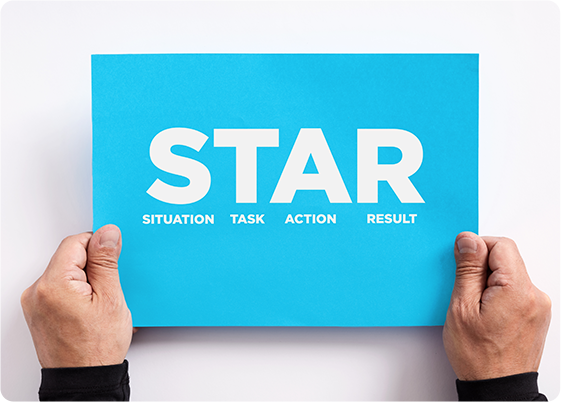
The STAR Method: How to Structure Any Behavioral Answer
The STAR method gives you a simple structure for answering common behavioral questions clearly and logically.
Situation: Briefly explain the situation or context you were dealing with.
Task: Describe your responsibility or what you needed to accomplish.
Action: Explain the specific steps you personally took.
Result: Share the outcome and, when relevant, what you learned.
This is a fairly foolproof system when tackling the most common behavioral interview questions. This can give you a reliable structure to answer the questions without veering away from the core point.
For more general preparation, review these job interview tips.

10 Common Behavioral Interview Questions and How to Answer Them
Here are 10 most common behavioral interview questions that employers rely on to evaluate a candidate’s workplace skills, judgment, and overall attitude:
Tell Me About a Time You Had a Conflict With a Coworker. How Did You Handle It?
This gives you an excellent opportunity to share an example in which you managed to resolve a dispute in a professional manner. Please give one example of a situation in which you have managed to resolve a dispute in a professional way. For example, you can say that you had a difference of opinion with a colleague about task allocation.
Tell Me About a Time You Worked Closely With Someone Whose Personality Was Very Different From Yours?
It gives the interviewer insight into how you work with others, particularly how you will work well with people with different personalities. You could tell the interviewer about the incident where you had to work with a colleague who had a completely different way of approaching problems. Mentioning that in such a case, you had to rely on the processes already in place and the directions given by your superior will work in your favor.
Strong communication skills at work can help people with different approaches work toward the same goal.
Tell Me About a Time You Made a Mistake at Work. How Did You Resolve It, and What Did You Learn?
Choose a mistake that you made but corrected responsibly. Describe the mistake, who you told about it, what you did to fix it, and what changes you made to avoid the same mistake again.
This is one of the basic behavioral interview questions employers can use to assess accountability and self-awareness.
Tell Me About a Time You Failed. How Did You Deal With the Situation?
Describe a scenario where things did not go according to plan but turned out to be a positive lesson. State what was expected, why it failed, what was learned from that failure and how it was applied. Do not blame the failure on your colleagues, management and others.
Tell Me About a Time You Were Under a Lot of Pressure at Work or School. How Did You Get Through It?
Give a practical illustration of a stressful situation, and show how you handled task prioritization, time management, or got help as needed in this situation. This should illustrate your ability to be well-organized and efficient despite the existence of stress.
Describe a Time When Your Company Was Undergoing Change. How Did You Adapt?
Provide an example of any type of change which you have experienced. This includes change of systems, procedures, management, scheduling, and responsibilities. How were you aware of what was expected from you? How did you adjust yourself and finish your tasks?
Adaptability is one of the traits that is most often evaluated by employers as the workplace keeps on changing.
Describe a Time When You Had to Step Up and Demonstrate Leadership Skills.
One does not have to hold any managerial position to answer this question. One can talk about the time when one coordinated a group activity or assisted a new team member. Describe what had to be done, how one acted proactively, and what the outcome was of the actions taken.
Tell Me About a Time You Went Above and Beyond Your Job Description.
Describe one instance where you added some extra value to your job without neglecting your regular duties. It may be something like helping a co-worker out or managing a situation that was not expected by the customer. The most successful answers are those which explain why you took that step and its results.
Tell Me About a Time You Turned an Unhappy Customer Into a Satisfied One.
This is particularly important for customer service jobs. Explain how you listened to the customer, acknowledged the problem, found an appropriate solution to the problem, and made sure that it was sorted out. In reviewing the list of behavioral interview questions and their answers, keep in mind that many employers value your thought processes more than the end result.
Why Do You Want This Job, and What Motivates You to Do Your Best Work?
Although this question is broader than many behavioral prompts, your answer should still include specific evidence. Connect the role to your skills, interests, career goals, or motivation to help customers and contribute to a team.
The most popular behavioral interview questions often reveal both what you have done and what motivates your approach to work.

Common Mistakes to Avoid When Answering Behavioral Questions
Even highly effective instances can be made ineffective because of poor presentation. In answering typical behavioral questions, take care that you don't do the following:
- Answer in a very general or vague way instead of mentioning just one specific instance.
- Exceed two minutes when talking about it by giving unnecessary details about it.
- Mention a fictional instance which could be difficult to verify once the interviewer asks for more information.
- Not mentioning the "results" element of the STAR method in your answer.
- Say anything negative about former colleagues, superiors, customers, or employees.
- The point is not to paint yourself as a flawless applicant with no issues or challenges at all.

How to Prepare for a Behavioral Interview
Through preparation, you will be able to answer the behavioral questions in a natural way without necessarily learning how to do it. You begin with the identification of five to six real experiences from your past job, school, volunteer work, or any other situation. From the experiences identified, select those experiences that can be used to showcase different skills like conflict management, teamwork, failure situations, adaptability, customer care, leadership skills, problem-solving, among others.
After that, match your experiences with different interview questions. Each one of your experiences might help you demonstrate more than one competency depending on how you portray it. Practice answering these questions using the STAR technique, ensuring that your answers do not exceed two minutes.
You should also prepare questions of your own. Reviewing questions to ask a call center interviewer can help you make the interview a more useful two-way conversation.
Final Thoughts
By preparing yourself for the most frequently asked behavioral questions, you will be able to talk about your experiences confidently and in a structured way. You don’t have to have a perfect story. All you have to do is provide genuine and specific examples of how you dealt with various situations.
Use the STAR technique, choose examples to highlight your various strengths, and stick to what you did and learned.
If you are preparing for your next opportunity, explore current customer service jobs at HGS USA and find roles where you can put your communication, problem-solving, and customer service skills to work.
FAQ
-
What Is the Difference Between Behavioral and Situational Interview Questions?
Behavioral questions pertain to your past experiences. Situational questions focus on how you would behave in a future situation.
-
What Is the Best Way to Answer Behavioral Interview Questions?
Use the STAR technique in answering this question. Provide an example where you describe the Situation, Task, Action and Result.
-
How Long Should a Behavioral Interview Answer Be?
Aim for one or two minutes. Be sure to give enough detail to justify your actions but without any extraneous background information.
-
What Skills Do Behavioral Interview Questions Assess?
They can evaluate communication skills, teamwork, leadership, adaptability, problem-solving, accountability, customer service, and decision-making.